From Tweets to Skeets
Launching Astronauts on Twitter (My Ex-X) to Navigating Bluesky’s New Orbit

After years of what I can only describe as a codependent relationship, I’ve finally broken up with Twitter. Well, I guess it’s “Ex-Twitter” now, or maybe “X,”—but it’s still hard to shake the feeling of being stuck in an endless cycle of notifications, arguments, and algorithmic chaos. It’s like leaving behind a long-term relationship with its ups and downs, but in the end, you realize it’s not good for you anymore. X, or whatever it wants to call itself, and I—we’ve parted ways.

But now, I’m here, navigating a new platform—Bluesky. And let me tell you, it feels like a fresh start. It's like stepping into a world still figuring itself out but in a less overwhelming way and more inviting. There’s a sense of discovery here that I haven’t felt in years.
Bluesky feels like stepping back in time—a throwback to the early days of Twitter, when the internet was still a bit of a wild frontier, full of potential, with just enough chaos to be exciting but not overwhelming. And no one is taking anyone to the train station. Back then, conversations were shorter, lighter, and infused with a sense of discovery, not bogged down by endless algorithms or scorched-earth political debates. Bluesky has somehow managed to capture that same sense of spontaneity and curiosity, a rare breath of fresh air amidst the smoke and mirrors of other platforms.
It’s like showing up to a dinner party where everyone’s already laughing at some shared inside joke. You’re not sure how you missed the punchline, but the group is so welcoming that they’re happy to fill you in, no judgment. You’re invited to the table and encouraged to join the conversation, even if you don’t quite speak the language yet.
This feeling of getting in on the ground floor reminds me of my first experience with social media. As a former NASA Public Affairs Officer, I had a front-row seat to the early days of astronauts on Twitter—a much more covert mission than most people realize. NASA management wasn’t entirely convinced that social media was a good fit for the space agency, and there was a lot of pushback.
Getting astronauts on Twitter was like convincing someone to take a risky leap into the unknown—full of hesitation and skepticism. The irony wasn’t lost on me: astronauts were ready to climb into a rocket with 7 million pounds of thrust to venture into the vast abyss of space, yet reluctant to leap into the comparatively tame unknown of social media. But I knew it could be a game-changer.
I began by quietly testing the waters, asking a few astronauts if they’d be willing to explore this new frontier of social media. But there was a lot of reluctance as if stepping into the unexplored territory of Twitter was a more significant leap than venturing into space itself. Finally, a few trusted me with the idea, agreeing to give it a shot—if I could clear it for takeoff. At the time, there was no internet aboard the Space Shuttle or the International Space Station, but that didn’t stop me. I was undeterred.
When my now-husband, Scott Kelly, was set to fly on STS-118, it marked a significant milestone in NASA’s history. The mission included Barbara Morgan, who had been selected as the backup “Teacher in Space” for the Challenger flight and was finally fulfilling that role 21 years later. I saw an unmissable opportunity—NASA needed to share this powerful moment with the world in real-time. It felt like the perfect chance to send the first tweet from space.
I requested that Scott, as the mission commander, join Twitter to participate in this milestone. However, the response I received from NASA’s Astronaut PAO was a firm “no.” Scott was adamant about not participating, and my PAO colleague advised me to let it go. But something in me refused to give up on this idea.
I didn’t fully grasp it at the time (nor did Scott), who was initially hesitant to participate, feeling it could distract from the mission and violate his crew’s privacy. But now I understand how this real-time connection helps astronauts and their loved ones back home. What I did know then was that it would be a powerful way to share the space experience with people on Earth, fostering a new level of engagement with the mission.
For NASA, a government agency with no advertising budget, social media became an effective and cost-efficient tool for engaging the public in ways traditional outreach couldn’t achieve.
A little more than two years later, I turned to Mike Massimino, a fellow astronaut with a natural ease in the spotlight and a strong desire to connect with people—qualities that made him a perfect candidate for Twitter.
By this time, NASA was still hesitant about astronauts engaging on Twitter, and the landscape had only grown more complex, with ongoing debates about the role of social media in space exploration. But after some convincing, Mike agreed to give Twitter a try.
The catch?
There was no internet on board, but Mike had email access. So, as he prepared to embark on his mission to the Hubble Space Telescope, he planned to email me his tweet once in orbit, and I would post it for him. That tweet became the first ever sent from space—though, technically, I posted it.
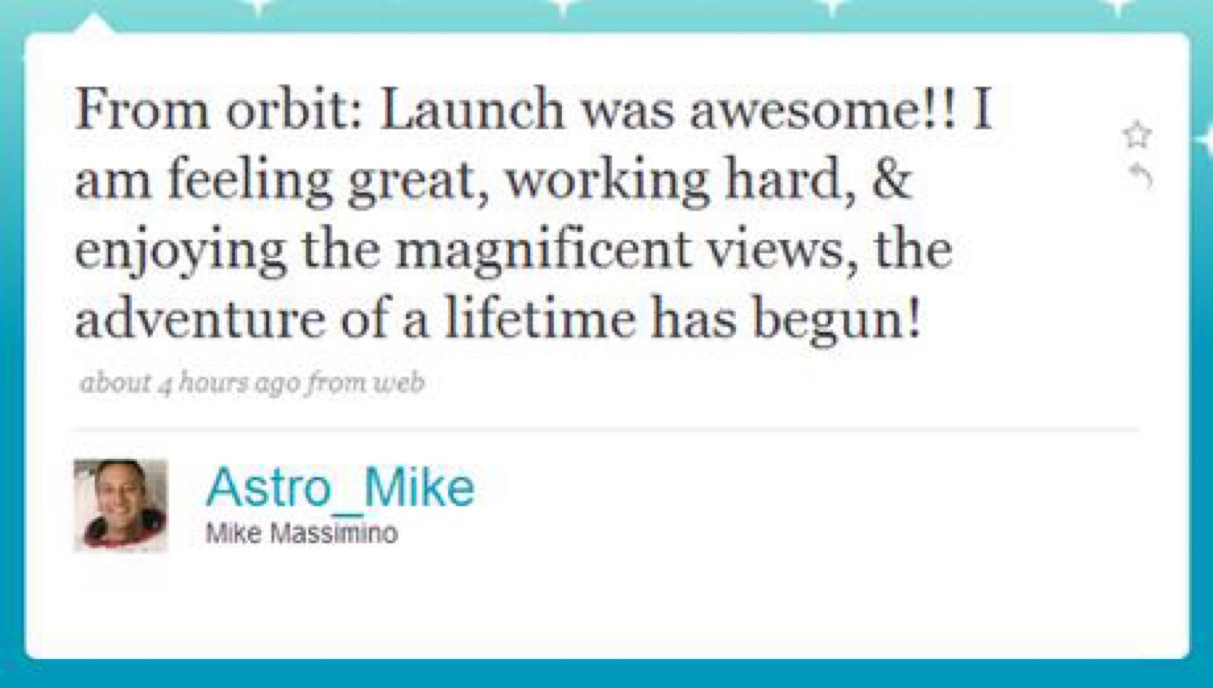
To this day, I tease Astro Mike, now a personal friend, that while he touts himself as the first to tweet from space, the reality is that it was a collaborative effort. It was me who posted it, and I’ve not yet been to space.
Eight months later, on January 22, 2010, Mike’s astronaut colleague Timothy (TJ) Creamer tweeted unassisted, marking the first live tweet sent directly from orbit. Before hitting send, TJ even gave me a quick call from space, ensuring everything was ready for this historic moment.
Now, social media feels a little… fractured. A recent post on Threads read: ‘I think we’re just seven more social media apps away from fixing everything,’ and it resonated. With platforms like Bluesky, Threads, Mastodon, and others emerging, we’re splintering into smaller online communities, each with its own quirks and dynamics.
Threads tried to feel like Instagram’s laid-back sibling but has leaned a bit corporate. Mastodon gives off a “Linux-user-only” energy. And X? Well, X feels like the dystopian mall we can’t stop returning to, even though half the stores are boarded up. And then there’s Bluesky.

With its quirky lexicon and nostalgic charm, Bluesky promises something different—a less chaotic, more intentional space. Posts are no longer tweets; they’re “skeets.” Instead of a retweet, you’ll “re-skeet.” And the term “sky people?” It feels like being invited into a secret club that doesn’t take itself too seriously.
But there’s hesitation. Many of us are reluctant to leave platforms like X, where followings have been built and time has been invested in growing a presence. It’s hard to walk away when follower counts hold such significance for some. I have a little more than 10,000 followers on X, though that number has been dropping recently, while on Bluesky, I’m still under 200. This raises a bigger question: is it worth staying for the followers, or should we seek spaces more aligned with our values?
People are noticing: Bluesky recently surpassed 16 million registered users. This surge hasn’t been without its hiccups. My handle appeared invalid the day I joined last week, prompting me to joke about working it out in therapy. It was a server glitch due to so many new sign-ups. So, I saved a session and $150. Still, Bluesky’s growth shows it’s carving out its orbit in the social media universe.
But can Bluesky deliver on its promise of a more intentional space, or are we just bouncing from app to app as if rebounding, hoping one of them will magically fix what Elon Musk, in his misguided attempt to champion free speech—often at the cost of enabling hate speech—broke? Ironically, Musk has also been quick to cancel the free speech of others who disagree with him, adding another layer of hypocrisy to the chaos he created. The more platforms we make, the more we fracture our digital selves into tiny, disconnected worlds. We go from one app to the next, hoping one will be different and better—like the uncharted territory we first discovered when Twitter (my Ex-X) felt new and revolutionary.
The real test for Bluesky will be how it balances its growth with the unique vibe it’s cultivating. Will it stay in this charmingly small town or become the next big, noisy metropolis of digital chatter? Will it preserve that sense of being in on the joke, or will the corporate pull and scale of the platform eventually make it feel just like the others?
For now, though, I’m enjoying the quirky charm of Bluesky. Skeeting feels less like yelling into the void and more like chatting with a room full of witty, slightly nerdy friends. And while I can’t promise I’ll remember to “skeet” instead of “tweet” every time, I can say this: it’s nice to find a corner of the internet that doesn’t feel so heavy—especially when life feels weighty enough, and current U.S. politics seem to get heavier by the day. Maybe, just maybe, skeets can be a little more productive and thought-provoking, offering a reprieve from the chaos.
So, here’s to learning a new lexicon, embracing the quirks, and maybe, just maybe, finding a little less chaos along the way. But if seven more apps pop up tomorrow? I’ll be there—skeeting, threading, and whatever else the internet throws my way. I’ll be everywhere, just not there—you know, (back with my X) because any therapist will tell you to cut all ties to a manipulative, self-absorbed hate baiter, establish boundaries, and reclaim your peace.

.